SSourcebound Prep
Since 1877
December 2026 window

Free Texas U.S. History EOC practice, 2026-27

Pass the Texas U.S. History end-of-course exam. Every answer sourced.

Three full-length practice forms built to the state's design, 64 questions and 78 points each, with the select-two and two-part questions the real test uses, scored by reporting category and performance level. Each of the 224 explanations names the document, case or law it comes from, so you can check it yourself.

Start Practice Test 1How the exam worksNo account. No tracking. Your progress stays in this browser.
224original questions
3full-length forms
23 / 78Approaches line, spring 2025
$0free, no account
Live sample
Government and CitizenshipSample question

Our constitution is color-blind, and neither knows nor tolerates classes among citizens. In respect of civil rights, all citizens are equal before the law. Justice John Marshall Harlan, dissenting, Plessy v. Ferguson (1896)

The majority opinion that Harlan was disputing established which rule?

Plessy upheld a Louisiana law requiring separate railway cars by race, reasoning that separation did not imply inferiority; that separate but equal doctrine licensed Jim Crow segregation for nearly sixty years. Equal protection is the text of the Fourteenth Amendment, which the majority read narrowly, not a rule it created. The inherently unequal holding came in Brown v. Board of Education in 1954, which rejected Plessy in education. The case did not turn on interstate commerce; Plessy's journey was within Louisiana.
Source: Opinion: Plessy v. Ferguson, 163 U.S. 537 (1896), Harlan dissent, paragraph beginning 'The white race deems itself'; majority opinion
Every question on this site works like this.Start the full test
Every explanation cites its sourceTimed to the expected 3 to 4 hoursScored by reporting category, like the state reportNo account, no tracking
Preview: the practice forms here use the questions written so far (224 of 224). The full bank, three forms and the glossary deck arrive as the writers finish; nothing you do here is lost.

Choose your path

Three full-length forms, built to the state's design.

64 questions each, 78 points, mixed across the four reporting categories the way the real test is. Take one timed, read every explanation, then come back for the next.

Practice Test 1

64 questions, 78 pointsOptional 4-hour timer

Mixed across the four reporting categories like the state form. Every answer explained from its source when you finish.

0%

Practice Test 2

64 questions, 78 pointsOptional 4-hour timer

Mixed across the four reporting categories like the state form. Every answer explained from its source when you finish.

0%

Practice Test 3

64 questions, 78 pointsOptional 4-hour timer

Mixed across the four reporting categories like the state form. Every answer explained from its source when you finish.

0%

By reporting category

Drill the four categories the state scores.

An eight-question quick check for each, or study every question in a category with instant feedback and sources.

History

Eras and turning points from 1877 to the present: the Gilded Age, world power and World War I, the Progressive Era, the 1920s, World War II, the Cold War, civil rights, and the decades since.

95 questions

Geography and Culture

Geographic factors behind major events, migration and immigration, population and the environment, the arts, and the groups that shaped the national identity.

41 questions

Government and Citizenship

The changing role of government, the three branches, landmark Supreme Court decisions and amendments, civic values, participation, naturalization, and leaders.

35 questions

Economics, Science, Technology, and Society

The economy from the railroads to the New Deal, war and postwar policy, trade, and the effects of science and technology on work and the standard of living.

53 questions

Flashcards

298 cards

Events, laws, cases, people and terms, each citing where it comes from. Flip, mark what you know, keep what you do not.

Open flashcards

Study mode

224 questions

Work through every question in a category with the explanation and source shown the moment you answer. Shuffled each time.

Start studying

Your progress

Earn your way past Approaches.

Saved in this browser only, nothing sent anywhere. Badges mark the milestones that matter on test day.

0full tests completed
–best score of 78
0questions answered
0day streak
First QuestionAnswer your first question
Quick CheckFinish any 8-question quick check
Full DressComplete a full-length practice test
Passing GradeReach the Approaches Grade Level equivalent on a full test
ScholarReach the Meets Grade Level equivalent on a full test
MastersReach the Masters Grade Level equivalent on a full test
Perfect SectionEarn every point in a reporting category on a full test
Four PillarsPass all four quick checks
MarathonComplete all three full tests
Card SharpFlip 100 flashcards
Source ReaderOpen 10 source citations
Three-Day StreakPractice three days in a row
Seven-Day StreakPractice seven days in a row

See your full history and category mastery

How the scoring works

78 points. Three lines.

The state converts raw points to a scale score and reports one of four performance levels, plus a score for each reporting category. Every practice form here reports the same way.

23of 78 to approach
Approaches 23Meets 37Masters 51
020406078

On the spring 2025 form, Approaches Grade Level (the graduation standard) was 23 of 78 points, Meets 37 and Masters 51. The points needed move a little with each form. Students are expected to finish within three to four hours and may keep working until the end of the school day.

Built from the sources

Not built to be believed. Built to be checked.

Most prep material is written from summaries. Every question here was written from the public record it tests, and the explanation tells you which one.

Written from primary sources

National Archives milestone documents, treaties, statutes and executive orders; Supreme Court opinions; the presidential libraries' texts of speeches and messages; and the histories and data of federal agencies.

Checked by script

Every date, amendment number and case holding was cross-checked against a fact table built from those sources, and every quotation matched word for word. Unique options, balanced keys, no duplicates, the state's category split on every form.

Reviewed independently

The questions were drafted with AI tools under human editorial direction. Independent model reviewers then tried to prove each keyed answer wrong or ambiguous, and flagged items were rewritten or removed. Corrections, if ever needed, are posted openly.

How the questions were built and checked, with the full source list
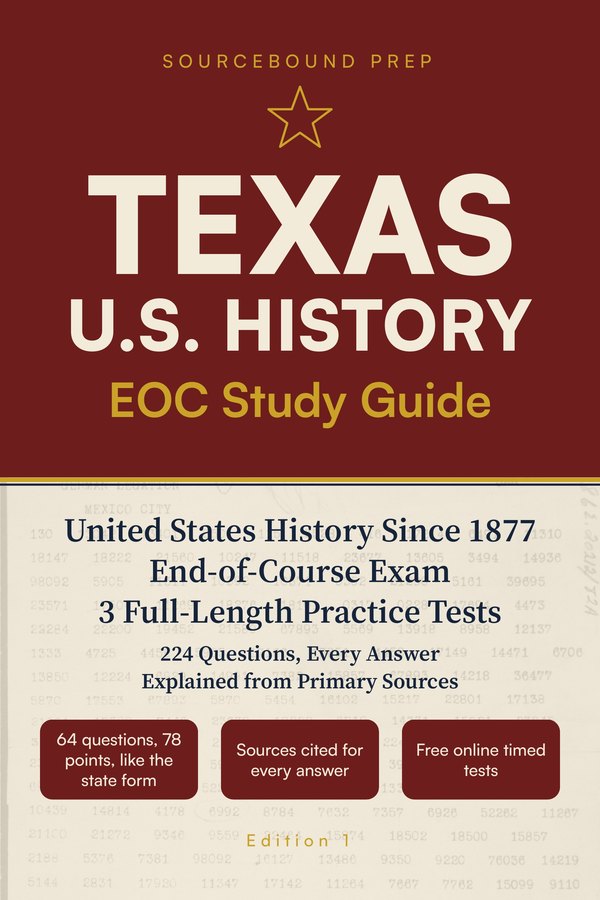
Front cover of Texas U.S. History EOC Study Guide, edition 1

The printed companion

Texas U.S. History EOC Study Guide

United States History Since 1877 End-of-Course Exam: 3 Full-Length Practice Tests, 224 Questions, Every Answer Explained from Primary Sources

Coming to Amazon 20276 x 9 in paperback and Kindle edition.
  • Three full-length practice forms, 64 questions and 78 points each, with scoring by category
  • Four review chapters, one per reporting category, with the facts the exam tests
  • Quick-review sheets, a 3-week study plan and a glossary that doubles as a flashcard deck
  • Every explanation names its source